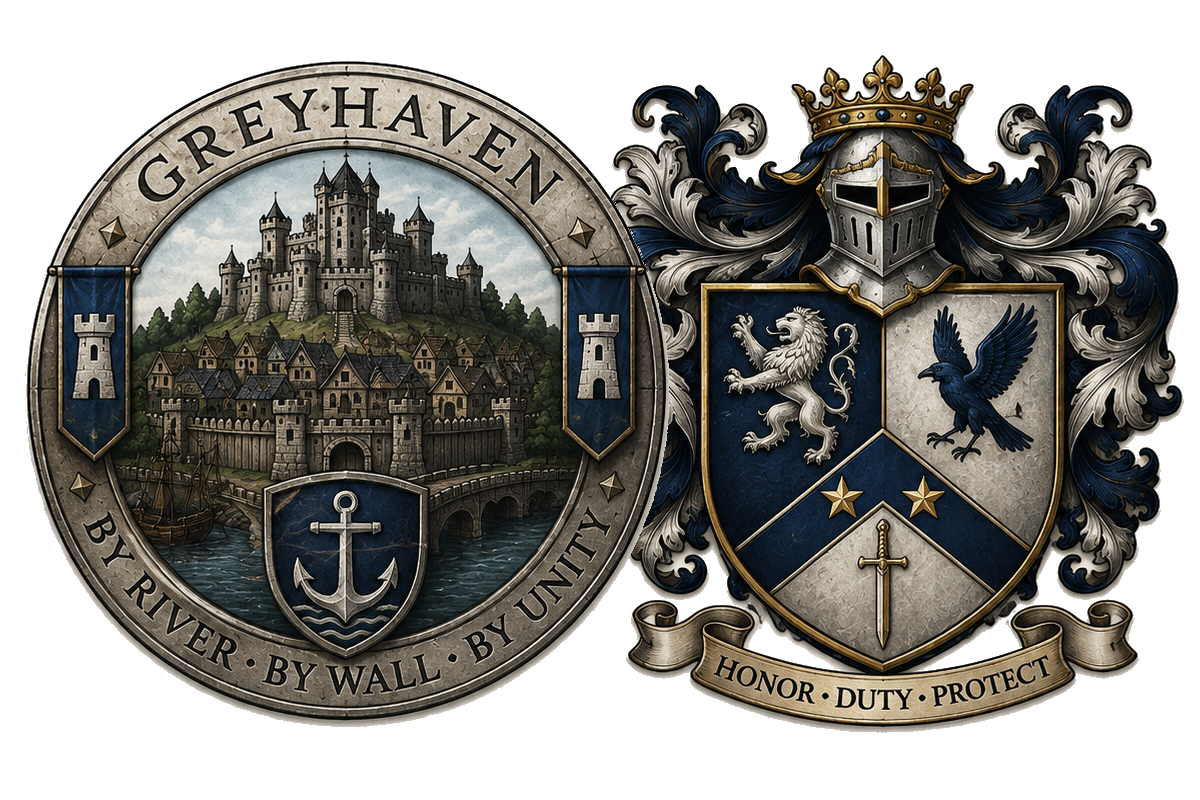
The Chronicle of the First Dawn
The Creation of the World, the Great Ages, and the Reckoning of GrayHaven
Among the scholars of Valedorn, the oldest surviving histories begin with a warning:
“What came before the gods is not forgotten. It simply has no name.”
No mortal knows whether the tale that follows is literal history, divine allegory, or merely the oldest story people have managed to keep telling.
I. Before the World
Before earth, before sky, before the moons turned above the night, there was the Vast.
It was neither darkness nor emptiness, for darkness requires light to define it and emptiness requires something that might fill it. The Vast simply was.
Then came the First Sound.
No scripture agrees upon what caused it. The priests of Lumiona claim it was the first declaration of existence. Followers of Numinara insist it was the Vast dreaming. Some wizards suggest the universe itself became unstable and simply happened.
Whatever the truth, the First Sound shattered the stillness.
From its echoes emerged the first divine powers.
They were not yet gods in the forms mortals recognize. They were ideas given will: light, darkness, change, life, death, wilderness, knowledge, creation, destruction, fortune, memory, and countless other forces whose names have since vanished.
From these powers arose the gods now remembered in the oldest pantheons: Asra, Lumiona, Melita, Santtu, Numinara, Svar, Elbridge, Cetra, Luitgard, Eetu, and Kyfun.
Other divine beings existed beside them.
Some died.
Some departed.
Some were imprisoned.
And some, according to forbidden texts, merely wait.
II. The Making of the World
The gods discovered that thought could shape the Vast.
And so they began to create.
Mountains were raised where divine hands pressed against nothingness. Oceans poured into the valleys. Rivers traced themselves across newly formed continents. Stars were scattered throughout the heavens.
But the gods did not always agree.
Where two divine wills collided, strange things happened.
Magic entered creation.
It pooled beneath mountains, flowed along invisible currents through the earth, and occasionally erupted into places where reality became thin. Scholars would eventually call these currents ley lines, although druids maintain that they are simply the veins of the living world.
Life followed.
Forests spread.
Creatures crawled from primordial seas.
Dragons appeared during these earliest days, and many dragons still insist that they were created before mortals and therefore possess the older claim to the world.
Then came the speaking peoples.
Elves remember awakening beneath trees illuminated by two moons.
Dwarven tradition says their ancestors were carved from mountain stone and awakened by divine fire.
Halflings say the gods created everyone else first, realized they had made the world entirely too serious, and corrected the mistake.
Humans possess approximately three hundred competing creation stories.
Dragonborn histories claim descent from the first great dragons.
Goliaths tell of ancestors who walked down from the peaks when mountains were still warm.
Firbolg oral tradition claims something considerably different:
the forests were already inhabited when everyone else arrived.
They refuse to elaborate.
III. The Two Moons
When the world was young, night frightened the first mortal peoples.
Lumiona therefore placed a lantern in the heavens.
But Numinara warned that no single light should rule the darkness.
Thus appeared the two moons.
Aureth — the Bright Moon
Pale silver and steady, Aureth became associated with navigation, protection, prophecy, and lawful magic.
Veyra — the Wandering Moon
Smaller and faintly blue, Veyra moves through its cycle differently from Aureth and became associated with dreams, transformation, secrets, wilderness, and strange magic.
When both moons are full together, the night is called a Twin Vigil.
When both disappear simultaneously, it is called the Godless Night.
Superstitious people remain indoors.
Experienced adventurers do too.
THE GREAT AGES
Modern Valedorn scholars divide history into seven great ages.
Dating events before the Fourth Age is notoriously unreliable. An elven chronicle describing something as occurring "three generations ago" may unfortunately mean eight hundred years.
FIRST AGE — The Age of Making
Before recorded years
The gods shaped the world and the first mortal peoples appeared.
Dragons dominated enormous territories. Primordial creatures wandered forests that stretched across entire regions.
Magic existed everywhere but possessed little structure. Mortals did not study magic. They encountered it.
The earliest druids learned to listen to the living world. The first clerics discovered that divine beings sometimes answered prayer.
The earliest arcane practitioners discovered something much more dangerous:
the gods were not the only source of magic.
Great Events
The First Dawn — Lumiona brought light into the newly formed world.
The Raising of the Mountains — enormous mountain ranges appeared during conflicts among primordial powers.
The Green Awakening — forests spread across the continents.
The Coming of the Dragons — the great draconic bloodlines emerged.
The Gift of Speech — the mortal peoples developed language and civilization.
The Hanging of the Moons — Aureth and Veyra were placed in the heavens.
The Age of Making ended when mortals constructed permanent cities.
SECOND AGE — The Age of Wonders
Approximately 12,000–7,000 years before the present
Civilization exploded across the world.
Elven kingdoms stretched through enormous forests.
Dwarven holds tunneled beneath entire mountain ranges.
Human kingdoms appeared along rivers and coastlines.
Giants constructed citadels whose ruins still dwarf modern fortresses.
Magic advanced astonishingly quickly.
Wizards learned teleportation, planar travel, magical construction, and methods of keeping enormous structures suspended in the sky.
The first vessels capable of traveling beyond the ordinary world appeared during this age.
Modern scholars debate their nature.
Adventurers have another name for them:
Spelljammers.
Great Events
The Founding of the First Cities
The Dragon Wars — mortal kingdoms challenged draconic dominion.
The First Arcane Colleges
The Opening of the Ways — portals connected distant kingdoms.
The Star Voyages — magical vessels traveled beyond the world.
The Great Concordance — powerful civilizations attempted to organize and regulate arcane knowledge.
For several thousand years, civilization accomplished things that modern wizards struggle even to understand.
Then someone went too far.
THIRD AGE — The Age of Ruin
Approximately 7,000–5,600 years before the present
Nobody knows exactly what caused the Sundering.
Every explanation contradicts another.
Some claim mortal wizards attempted to become gods.
Others say an ancient civilization opened a gateway to somewhere that should never have been reached.
Dwarven chronicles describe “the sky burning beneath the earth.”
Elven histories speak of “the night when magic screamed.”
Certain forbidden religious manuscripts suggest that one of the forgotten gods attempted to return.
Whatever happened, the magical networks connecting the ancient civilizations collapsed.
Cities vanished.
Floating fortresses fell.
Portals exploded.
Entire regions changed geography.
Creatures from other planes became trapped in the mortal world.
Some spelljamming vessels crashed.
Others disappeared.
And countless magical sites were simply buried beneath thousands of years of earth.
The Sundering
The catastrophe lasted generations rather than occurring in a single moment.
Civilization collapsed.
Nearly nine out of every ten settlements mentioned in surviving Second Age records have never been located.
The gods themselves seemed to withdraw from direct interference.
The Age of Wonders was over.
FOURTH AGE — The Age of Ash
Approximately 5,600–3,400 years before the present
The survivors inherited ruins they barely understood.
People lived inside shattered cities without knowing who constructed them.
Kingdoms formed around functioning wells, bridges, magical wards, and fortifications left by the ancients.
Monsters occupied abandoned territories.
Dragons reclaimed enormous regions.
Orcs, goblinoids, giants, and other peoples established kingdoms of their own.
Many modern dungeon complexes originate from this period because survivors repeatedly built fortifications on top of older ruins.
Then later civilizations built on those.
And then someone built a tavern over the whole thing.
Adventurers have been dealing with the consequences ever since.
Great Events
The Long Winter — volcanic ash and magical disturbances darkened several years.
The Wars of Reclamation
The Founding of the New Dwarven Holds
The Second Flowering of the Elves
The Restoration of the Temples
The First Reliable Calendars
The world slowly recovered.
FIFTH AGE — The Age of Crowns
Approximately 3,400–1,200 years before the present
Power shifted from isolated settlements to kingdoms.
Roads returned.
Trade expanded.
Coins became standardized.
Knighthood developed.
Guilds emerged.
Borders were drawn, disputed, redrawn, conquered, inherited, lost in card games, and occasionally rediscovered centuries later in inconvenient documents.
Much of modern political civilization originated during this age.
The lands that would eventually become Valedorn consisted of numerous competing kingdoms, marcher territories, dwarven enclaves, independent cities, and tribal lands.
Major Events
The Seven Crown Wars
The Great Orc Migrations
The Founding of the Merchant Roads
The Establishment of the Adventuring Charters
This last development proved surprisingly important.
Governments realized that sending heavily armed treasure-seekers into monster-filled ruins was significantly cheaper than maintaining armies specifically for that purpose.
The profession of licensed adventurer was born.
SIXTH AGE — The Age of Banners
Approximately 1,200–364 years before the present
The political landscape increasingly resembled the modern world.
The Kingdom of Valedorn emerged from alliances among several human realms, dwarven settlements, frontier lords, and independent cities.
The Valedorn crown gradually extended authority outward.
Not every region welcomed this development.
The frontier remained especially difficult.
Dense forests concealed ruins, hostile tribes, monsters, ancient roads, and territories where civilization had never completely returned after the Sundering.
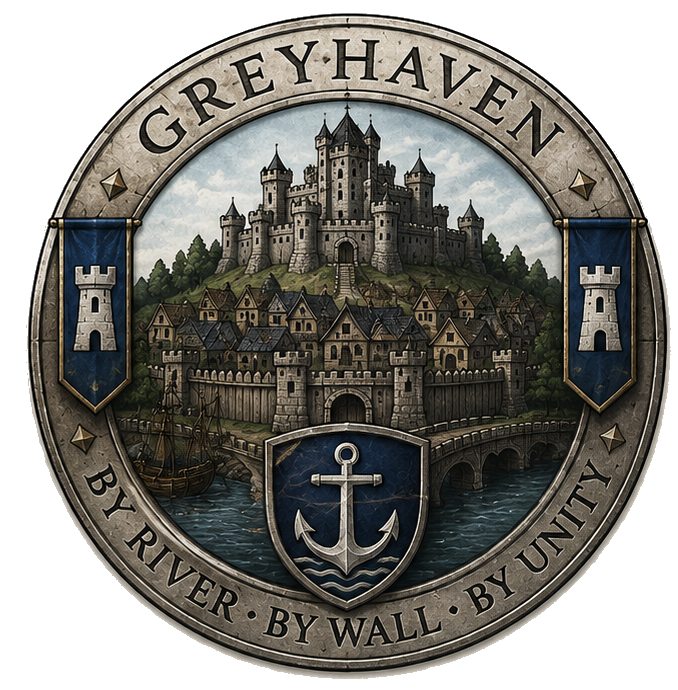
The Founding of GrayHaven
Approximately six centuries ago, travelers began using a sheltered crossing along the great river.
A crude trading post appeared.
Then docks.
Then warehouses.
Then walls.
The settlement became known as GrayHaven.
Its location proved invaluable.
River traffic could stop there before traveling deeper into the frontier, while overland expeditions could purchase supplies before entering the wilderness.
GrayHaven became the place where maps became uncertain.
THE ORC WARS
Roughly four centuries ago, large orc forces descended upon the region.
Several settlements disappeared entirely.
Battles raged through the forests and river valleys surrounding GrayHaven.
Some of the old battlefields remain recognizable today.
Others have been swallowed by forest.
Weapons, bones, fortifications, burial pits, and stranger remnants continue to be discovered.
GrayHaven survived.
Barely.
Its survival transformed the settlement from a trading post into a strategically important frontier town.
Valedorn began paying much closer attention.
SEVENTH AGE — The Age of Frontiers
364 years ago to the present
Modern historians consider the current era to have begun when King Edric II issued the Frontier Compact, reorganizing the eastern territories of Valedorn.
Marchlords were appointed.
Baronies established.
Roads expanded.
Mines reopened.
Fortifications appeared.
And civilization began pushing once again into wilderness abandoned since ancient times.
GrayHaven became one of the most important settlements in this effort.
That has created opportunities.
It has also created enemies.
RECENT HISTORY OF GRAYHAVEN
283 AF — The Silver Veins Rediscovered
Prospectors located valuable deposits in the wilderness beyond GrayHaven.
Mining camps followed.
Caravans became increasingly common.
So did bandits.
301 AF — Construction of the Modern Palisade
GrayHaven's older defenses were replaced by the substantial wooden walls recognizable today.
317 AF — The River Expansion
New docks and warehouses dramatically expanded river commerce.
The lower districts grew rapidly.
329 AF — The Adventurer's Guild Charter
GrayHaven formally recognized its Adventurer's Guild.
Explorers, mercenaries, monster hunters, treasure seekers, scouts, and professional trouble-solvers began using GrayHaven as their base.
338 AF — The Ivory Tower Awakens
The ancient structure now called the Ivory Tower became occupied once more.
Eventually the wizard Arlen Voss became its acknowledged master.
Exactly what lies beneath the tower—or whether Voss discovered everything already there—remains a favorite subject of tavern speculation.
347 AF — The Deep Flood
Unusually severe river flooding exposed entrances into previously forgotten passages beneath GrayHaven.
Some were sealed.
Some were explored.
Some were supposedly sealed.
There is an important difference.
352 AF — Cedric Valmont III Becomes Baron of GrayHaven
Baron Cedric Valmont III assumed authority over GrayHaven under the feudal structure of Valedorn.
His household and administration expanded as the town's strategic importance increased.
355 AF — The Frontier Road Initiative
Valedorn began encouraging greater settlement beyond GrayHaven.
New roads, logging operations, farms, mines, and satellite settlements appeared.
This expansion remains controversial.
Druids, wilderness peoples, hunters, old families, and others question how much of the frontier truly belongs to Valedorn simply because someone in a distant castle drew a line on a map.
The powerful firbolg hermit Thalen has occasionally aided GrayHaven against genuine threats while opposing expansion he believes threatens the ancient forest.
His snake Sissik reportedly has equally strong opinions.
357 AF — The Witchbriar Accord
The dangers outside GrayHaven's walls led to formal cooperation between the town authorities and the Witchbriar Rangers.
While the City Guard maintains order inside the walls, the Rangers patrol the roads, forests, trails, river approaches, and wilderness surrounding GrayHaven.
Their numbers remain small—roughly a score at any given time—but their knowledge of the frontier has saved hundreds of lives.
359 AF — The Pineford Compact
Regular trade and mutual-defense arrangements strengthened ties between GrayHaven and smaller settlements such as Pineford.
360 AF — The Grassvein Disputes
Territorial disagreements involving wilderness communities, settlers, hunters, and expanding commercial interests demonstrated that GrayHaven's greatest future threats might not all be monsters.
361 AF — The Caravan Years
Increasing numbers of traveling peoples began using GrayHaven's growing market.
Among them were the Veyrani, including the Saravelle clan, whose colorful wagons became a familiar if irregular sight around the town.
362 AF — The Year of Open Roads
Trade reached unprecedented levels.
So did disappearances along those roads.
The Witchbriar Rangers recorded increasing signs of monsters moving into regions where they had not previously been seen.
363 AF — The Year of Whispers
Rumors multiplied.
Ancient ruins were uncovered.
Strange lights were reported near forgotten battlefields.
Miners spoke of chambers that clearly predated the mines.
Travelers reported creatures behaving strangely beneath Veyra.
Several explorers quietly began searching for something supposedly hidden near GrayHaven since the Age of Wonders.
Most respectable scholars dismiss rumors of an intact ancient spelljamming vessel.
Most respectable scholars have also never been adventurers.
THE PRESENT YEAR
364 AF — The Year of the Twin Lanterns
AF means After the Frontier Compact, the dating system commonly used throughout this portion of Valedorn.
Older kingdoms and cultures possess their own calendars, but GrayHaven's clerks use AF dating for official documents.
King Aldric IV of Valedorn presently sits upon the throne.
The frontier province is governed beneath the authority of its Duke/Marchlord.
And beneath that authority stands:
Baron Cedric Valmont III of GrayHaven.
GrayHaven now contains roughly two thousand permanent residents, though merchants, sailors, miners, caravaners, adventurers, pilgrims, hunters, and travelers cause that number to fluctuate considerably.
The town stands where civilization meets something much older.
To the settled peoples of Valedorn, GrayHaven represents progress.
To merchants, opportunity.
To adventurers, employment.
To the crown, a strategic frontier stronghold.
To the forest, perhaps, it represents something entirely different.
TODAY IN GRAYHAVEN
Using GrayHaven's established 364-day calendar of thirteen 28-day months, I would place the opening present-day campaign date at:
18th Day of the 9th Month, 364 AF
The Year of the Twin Lanterns
It is Day 242 of the year.
Summer is weakening and the first signs of the coming autumn can be found along the frontier. Mornings beside the river have begun to carry mist. Merchants are thinking about what must be moved before winter. Farmers watch the sky. Woodsmen push farther into the forest while daylight remains plentiful.
The Adventurer's Guild is busy.
The Witchbriar Rangers are stretched thin.
Caravans continue arriving.
The silver mines require supplies and guards.
Arlen Voss remains in his Ivory Tower.
The Saravelle Veyrani travel the roads.
Thalen watches axes bite deeper into his forest and complains about GrayHaven to Sissik.
And beneath the town, behind ancient stonework nobody remembers building, water moves through tunnels older than the kingdom itself.
Farther into the wilderness stand ruins from civilizations whose names have disappeared from history.
Somewhere beneath earth, forest, mountain, or forgotten battlefield may lie relics of the Age of Wonders.
And somewhere in those forgotten places is evidence that the Sundering did not destroy everything it was meant to destroy.
The Seventh Age is not ending.
Something older is beginning to wake
Government
Grayhaven is technically a Barony, owing fealty to a distant king.
Daily law is handled by the Baron and Town Council.
Baron Cedric Valmont III
Male Human, age 57
- Stern but fair
- Former soldier
- Believes strength prevents war
- Personally inspects the walls every week
- Loves his people more than politics